Semi-algebraic geometry and generic Hamiltonian stability 

Santiago Barbieri (University of Girona)

The steepness property is a local geometric transversality condition on the gradient of a $C^2$-function which proves fundamental in order to ensure the stability of sufficiently-regular nearly-integrable Hamiltonian systems over long timespans. Steep functions were originally introduced by Nekhoroshev, who also proved their genericity. Namely, given a pair of positive integers $r,n$, with $r$ high enough, and a point $I_0\in \R^n$, the Taylor polynomials of those $C^{2r-1}$ functions which are not steep around $I_0$ are contained in a semi-algebraic set of positive codimension in the space of polynomials of $n$ variables and degree bounded by $r$. The demonstration of this result was originally published in 1973 and has been hardly studied ever since, probably due to the fact that it involves no arguments of dynamical systems: it makes use of quantitative reasonings of real-algebraic geometry and complex analysis.  In the first part of the presentation, I will explain the proof of the genericity of steepness by making use of modern tools of real-algebraic geometry: this allows to clarify the original reasonings, that were obscure or sketchy in many parts. In particular, Yomdin’s Lemma on the analytic reparametrization of semi-algebraic sets, together with non trivial estimates on the codimension of certain algebraic varieties, turns out to be the fundamental ingredient to prove the genericity of steepness. The second part of the presentation will be devoted to the formulation of new explicit algebraic criteria to check steepness of any given sufficiently regular function, which constitutes a very important result for applications, as the original definition of steepness is not constructive. These criteria involve both the derivatives of the studied function up to any given order and external real parameters that, generically, belong to compact sets. 
References: 
S. Barbieri “Semi-algebraic geometry and generic Hamiltonian stability”, Adv. Math. 482 C, 2025N. N. Nekhoroshev. Stable lower estimates for smooth mappings and for gradients of smooth functions. Math USSR Sb., 19(3):425–467, 1973.
 Infinite dimensional multifractals

Mathieu Helfter (ISTA)

In this talk, I will present a framework for multifractal analysis of infinite-dimensional measures. This us based on the notion of “scales,” which are finite metric invariants that generalize classical notions such as Hausdorff dimension and pointwise dimension of measures to both finite and infinite-dimensional spaces. We will focus in particular on the paradigmatic example of Brownian motion, whose multifractal spectrum can be described using measures associated with fractional Brownian motions. Since the Wiener measure cannot serve as a Haar measure, it is necessarily concentrated on a rich set of non-typical trajectories, whose scaling irregularities reveal its multifractal nature. We will also discuss several new questions and problems arising in this framework. The talk is based on joint work in progress with Aihua Fan.

ACIM instability of one-dimensional expanding maps through the lens of metastability

Abel Komalovics (University of Budapest)

If we have a family of expanding maps with unique ACIMs, then the ACIM stability of the family means that if the maps are converging to a limit map, then the densities converge to the density of the limit map. There are multiple papers showcasing ACIM instability, but all of them use methods specific to the families introduced in the papers. We develop a unified framework that allows us to use the tools of analysis of metastable maps. This way we can calculate the limit density, the finite dimensional distribution of the wandering of points and the diffusion coefficient.

Topological slow entropy of some skew products 

Nicanor Carrac (Jagiellonian University)

This talk is about topological $[T,T^{-1]$ systems, which are skew products built by taking a subshift in the base, a continuous cocycle to the integers, and an arbitrary invertible system in the fiber. The main result states that under suitable conditions the entropy of the fiber system can be recovered as the slow entropy of the skew product with a well-chosen scale. This is a topological analogous of existing results for measure-preserving   $[T,T^{-1]$ systems (Heicklen, Hoffman, & Rudolph; Ball; Austin). The main novelty it can be applied with zero-entropy systems in the base. This is based on the preprint https://arxiv.org/abs/2506.17932

A geometric approach to second-order superintegrable systems

Andreas Vollmer (Hamburg Universität)

Abstract: We introduce a geometric framework for second-order (maximally) superintegrable Hamiltonian systems on Riemannian manifolds of any dimension, encoding the system in a symmetric cubic tensor field (work with J. Kress and K. Schöbel). This approach allows one to interpret Stäckel transformations (coupling constant metamorphosis) of superintegrable systems in terms of a conformal geometry (or, more precisely, a Weylian structure).
The general framework will be exemplified for systems with a maximal number of compatible potentials and of linearly independent integrals of motion (“abundant systems”). This class includes the Smorodinski-Winternitz system, for instance. We find a natural correspondence between abundant systems and affine hypersurfaces (work with V. Cortés). On spaces of constant sectional curvature, abundant systems have an underlying Hessian structure (with J. Armstrong), and on flat space they correspond to solutions of the Witten-Dijkgraaf-Verlinde-Verlinde equation, allowing their identification with Manin-Frobenius manifolds.

On paramrtrized BBM technique and planar attractors (joint work with Jernej Cinc)

Piotr Oprocha (AGH Krakow)

Abstract: A very useful technique called BBM (Brown-Barge-Martin), incorporates inverse limits and natural extensions of the underlying bonding maps to embed attractors in manifolds.
The original idea goes back to the paper of Barge and Martin, where the
authors constructed strange attractors from a wide class of inverse limits.
One of the crucial steps for this technique to work is the usage of Brown’s approximation theorem.
Recently, this technique was extended to produce a parameterized family
of strange attractors.
In this talk we will present a few possible applications of BBM technique in a construction of concrete examples.

Applications of filtered Legendrian contact homology to contact dynamics

Michael Entov (Technion – Israel Institue of Technology)

Abstract: I will discuss how a filtered version of the Legendrian contact homology (a major object of study in contact topology) can be used to obtain new information about contact Hamiltonian flows on contact manifolds. The applications concern conformal factors of contactomorphisms and trajectories of contact Hamiltonian flows connecting two disjoint Legendrian submanifolds or starting on one of them and asymptotic to the other.


This is a joint work with L.Polterovich.

Period-Doubling Cascades Invariants

Eran Igra, Valerii Sopin (SIMIS – Shanghai Institute for Mathematics and Interdisciplinary Sciences)

Consider a rectangle map $H:ABCD\to\mathbb{R}^2}$ s.t. $H$ is a Smale Horseshoe map. Now, consider another map $G:ABCD\to\mathbb{R}^2$ s.t. $G$ is the identity (or more generally, some other homeomorphism with “simple” dynamics). By a classical result due to James Yorke and Kathleen Alligood we know that as we deform $G$ isotopically to $H$, more and more periodic orbits appear via period-doubling cascades, culminating in the chaotic dynamics of the Smale Horseshoe – i.e., we have a period-doubling route to chaos. That being said, due to the two-dimensional structure of the phase space we are free to choose many isotopies deforming $G$ to $H$ – and all feature a period-doubling route to chaos. This leads us to ask the following, natural question: can we somehow differentiate between different two-dimensional period-doubling routes to chaos?

It is precisely this question that we study in this talk. Using a mixture of Representation-Theoretic, Complex-Analytic, and Braid Theoretical tools we define topological invariants that describe how a given isotopy progresses from order into chaos. Following that, we exemplify how these invariants can be used to analyze the dynamical complexity of certain examples, including the Henon map – if time permits, we also discuss how these ideas can be generalized to a wider context.

Based on work in progress.

Symplectic blenders near whiskered tori and persistence of saddle-center homoclinics 

Dongchen Li (Imperial College London)

A blender is a hyperbolic basic set such that the projection of its stable/unstable set onto some central subspace has a non-empty interior and thus has a higher topological dimension than the set itself.We show that, for any symplectic Cr-diffeomorphism (where r is sufficiently large and finite, or r=∞,ω) of a 2N-dimensional (N>1) symplectic manifold, symplectic blenders can be obtained by an arbitrarily small symplectic perturbation near any one-dimensional whiskered KAM-torus that has a homoclinic orbit. Using this result, we prove that non-transverse homoclinic intersections between invariant manifolds of a saddle-center periodic point (i.e., it has exactly one pair of complex multipliers on the unit circle) are persistent in the following sense: the original map is in the Cr closure of a C1 open set in the space of symplectic Cr-diffeomorphisms, where maps having such saddle-center homoclinic intersections are dense. These results also hold for Hamiltonian flows in the corresponding settings.

Four cusps of caustics by reflection

Gil Bor (CIMAT)

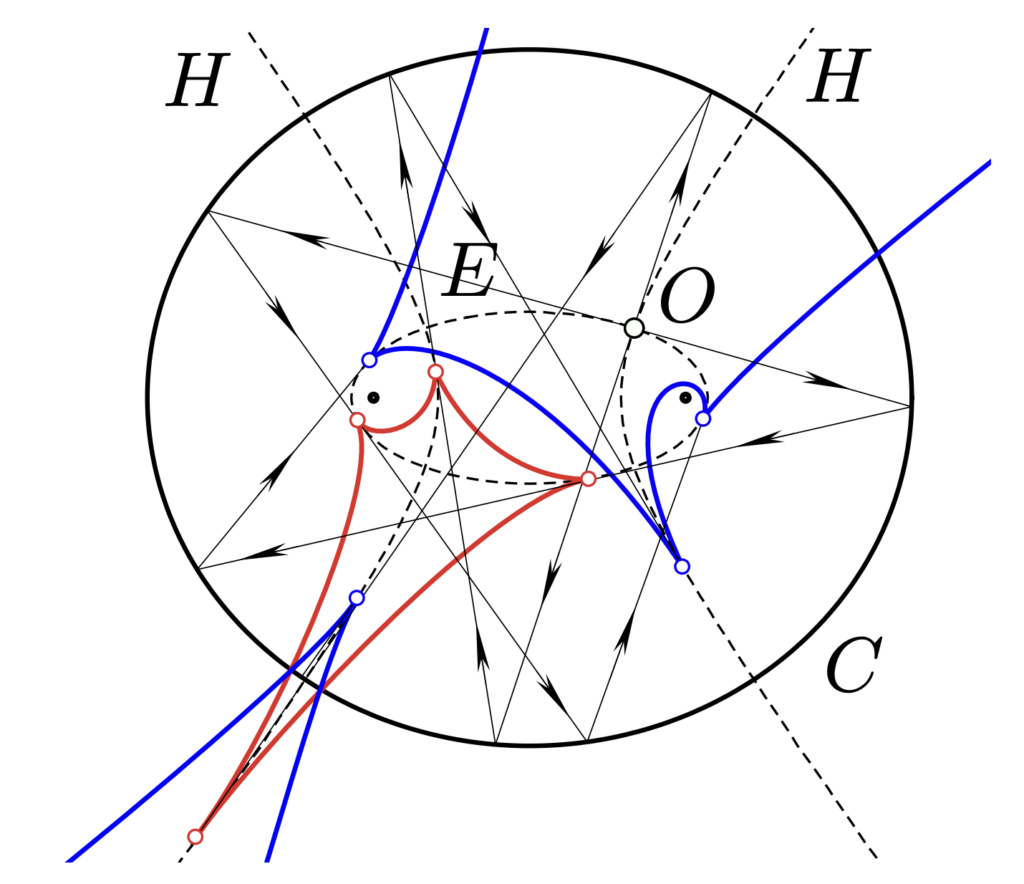
This talk is concerned with a billiard version of Jacobi’s Last Geometric Statement and its generalizations. Given a point O inside an oval billiard table (or mirror), one considers the family of rays emanating from O and the caustic (or envelope) of the reflected family of rays after n reflections off the walls of the table. I will describe two related statements:

(1) Theorem: for a generic O this caustic has at least 4 cusps for each positive integer n. 

(2)  Conjecture: for an elliptic table there are exactly four (ordinary) cusps. 

I will describe a proof of (1) and  partial results concerning  (2). 

This is joint work with Mark Spivakovsky (Toulouse) and Serge Tabachnikov (Penn State). 

References:

* https://arxiv.org/abs/2112.07852

* https://arxiv.org/abs/2406.11074.